
I’ve crossed the Atlantic twice, both times east to west. The first time, everything felt like a big deal because it was the first time. The second time, I thought I had a better sense of what was “normal.”
Turns out… there is no normal.
On my first crossing, we had what felt like a full collection of offshore, newbie “experiences.” At 1 a.m., mid-Atlantic, everything went dark— complete electrical blackout. No instruments, no lights, nothing. Just us, the boat, and a lot of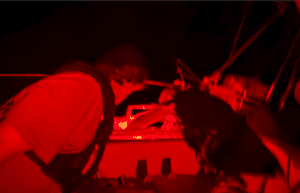 guessing. Concerns like what is the risk sailing without nav lights? And can we eat all the cheese before it goes bad? Not long after that, we discovered seawater above the floorboards, which is not a sight that improves your mood offshore. Even less so when you (I) find out that there are no working bilge pumps and the boat has to be hand bailed. That one was real. Another “leak” that caused a full spike in heart rate turned out to be the skipper’s hidden stashof beer slowly leaking into the bilge—which, in hindsight, was a much better outcome than the alternatives.
So by the time I set off on my second crossing, I was expecting fewer surprises. Maybe even something approaching routine.
Instead, mid-Atlantic, and in the middle of the night, we heard a noise that didn’t belong. You know the kind—where everyone looks at each other and no one wants to say it out loud.
The rudder stock had dropped. It was literally swinging.
Our first thought wasn’t elegant seamanship—it was: this could crack the hull. And if the rudder goes, you sink very quickly. So we didn’t hesitate. I called the only boat we could see on AIS right away and told them what was happening. They said they’d come get us if we were in the life raft.
We also got the ditch bag ready immediately—with passports,medicines, everything in the cockpit. It was the only time I’ve ever done that, and I  remember thinking, “Okay, this might actually be happening.”
Meanwhile, we got to work.
We used the emergency tiller to stabilize things from above and then started building what I can only describe as a questionable midnight engineering solution using ropes, fabric, and whatever we could find to stabilize it. The next day, we escalated: the skipper took a circular saw
to the settee boards and cut out a wooden “donut” to help brace the rudder stock in place. Not exactly factory spec.
It held—but barely, and not consistently. We were constantly adjusting, tightening, and re-rigging.
We had telemedicine support on standby, and I remember describing the situation and getting a very calm “Don’t worry, just keep going. Venezuela should be straight downwind”.
We reduced the sails to be conservative. Naturally, we went faster.
Only later did we find out what had actually happened: we’d been hit by a whale. The impact had cracked the rudder and the skeg, which explained why everything suddenly failed in such a dramatic way.
We managed to keep steering all the way across, nursing that setup, bailing water, and checking it obsessively. And somehow—despite all of that—we finished third out of nearly 100 boats.
It was, without question, one of the more stressful, but also confidence building, experiences I’ve had at sea.
If there’s a takeaway, it’s not that things go wrong offshore (they do). It’s that when they do, you don’t get to pause and think about it for very long. You just start solving the problem with whatever you have—and hope it’s enough. And bring a circular saw!