
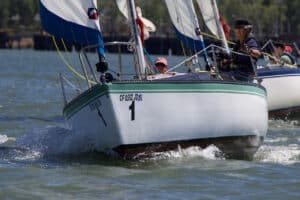
 I do Spinnaker team building sails during the day on Merit 25’s., Over the years, I have become familiar with the channel markers and landmarks in Redwood Creek and have occasionally found some of the shallow spots. After sailing in and out of Coyote Point for 40+ years, I moved my boat (Makani Kai) to Westpoint Harbor 3 years ago. Since then, I have sailed in and out numerous times during the day but have never tried to sail back after night fall.
When I saw that Spinnaker Sailing was having a night sail, I jumped at the chance to expand my comfort zone. I signed up to do a night sail with Spinnaker Sailing instructor Andrew Lesslie and a few Spinnaker students on Hurricane, the Beneteau 39.
The goal was to sail to ship channel marker “8” on the west side of the San Mateo bridge and return to Redwood City Municipal Marina after the sun had set.
I figured that going with an experienced instructor would be better than trying it on my own. I was right. This was a great way to acquaint myself with getting to know the area at night.
The schedule was set from 7 pm to 11pm. Sunset was forecast around 8:30.
In preparation for the night sail, I pulled out my paper chart 18651 of the south bay. I made a light list of the buoys going from ship channel marker “8” on the west side of the San Mateo Bridge back to the Redwood City Municipal Marina. I also collected the tide and current information and the forecast winds for the night. High tide was around 5:30. The ebb was starting around 7. Max ebb was around 9 and by 11 it was at the end of the ebb. Winds were forecast to be NNW 12-18 knots at 7:00 dying down to 3-5 at 11. Temperatures were to be 62o at 5:00 and 56o at 11.
Armed with that information, I debated on what to wear for the night. My normal gear for day sailing is my jeans, t-shirt, sweat shirt, hat, gloves, jacket, and sea boots. I used to do ocean races and the temperatures were in the low to mid 50’s. I would put on my full top and bottom thermals and overalls. I wasn’t sure of how to dress. I guessed that being warm and dry was better than being cold and wet. So, I put everything on this night. Good decision. I was comfortable all night.
Before we set sail, Andrew took a quick look at my light list and made a few well appreciated comments and corrections. I mistakenly assumed that the red and green buoys at the main span were lit. They are not. The main span bridge supports have red lights at the base while approaching from either direction and two green range lights above in the center of the span under the roadway. We also confirmed that my Garmin 78sc does not show channel marker light descriptions.
After the 3 other sailors arrived, Andrew had us check our PFD’s to make sure the inflation cartridges were current and armed. He also briefly went over a paper chart to show our plan to sail to ship channel marker “8” on the west side of the San Mateo bridge and back.
We left the dock at 7:15. The wind was approximately 12-15 knots from the west. In order to make it to ship channel marker “8” and back by 11:00 we opted to motor sail.
We put up the main sail with the first reef and rolled out the jib in the basin just outside the marina,
Continuing out the creek we tucked in a second reef in the main after channel marker “12”. At marker “10” we turned the corner and rolled up the jib. The wind was now 18-20 knots on our nose and a strong ebb started to build waves 1-2 feet as we approached the end of the creek. After creek channel marker “2”, the best we could do was 6-7 knots15-30 degrees off the wind on a port tack. We ended up getting to Sequoia Yacht Club mark “E” before tacking toward the center span of the bridge.
With the sun setting, we did another tack to get thru the bridge at 8:30. Once thru the bridge and another tack we headed toward ship channel marker “8”. By 9 o’clock the sun had set and we could clearly identify the flashing red light on marker “8” approximately a quarter mile away. We tacked and bore away to head back to the bridge. We were going DDW with following 1-2 foot waves on our quarter. The boat was squirely but manageable. We continued to motor sail at 5-6 knots against the ebb.
Andrew asked if any of the students wanted to steer. No takers. Too bad. Getting helm time in different conditions should be one of their main goals. I took over steering duties to give Andrew some respite. We had a clear view of the red and green lights marking the main span. While I wrestled to keep us on course, the rest of the crew kept an eye out for the unlit red and green cans. I was too busy steering to see them but Andrew assured me that if I kept the green center lights in line, I would be OK. This is where his local knowledge really shines.
Another jibe after the bridge and we were DDW on the other tack with 1-2 foot waves still on our other quarter. For the next hour or so I had to concentrate on our course in order to not do an accidental jibe. With the dodger obscuring my view, I had to stand and lean out to be able to range on lights in the distance. I had no time to look at the chart plotter in the center of the boat or other instruments.
Blind as a bat. Did I mention we pounded up wind going to Channel marker “8”? We took on some spray and my glasses got wet. During the day I can usually see through the drops but after dark, any light I see is either multiplied or looks like star bursts. A little nerve racking.
I scanned the horizon and spotted the last set of 3 red tower lights on the east side of the Dumbarton Bridge. I kept those lights at about 15 degrees off my starboard bow. As Andrew pointed out the different tower lights and stars to the crew, I continued to concentrate on steering. I figured if ship channel marker “12” was within those clusters of red lights to starboard I was safe of not hitting it.
After an hour or so, Andrew pointed out Redwood Creek channel marker “2”. We jibed again and headed toward the creek. As we entered the creek, the waves subsided to 1 foot or less. Now I could see markers “3” and “4” in the distance but could not really tell if I was sailing in the center of the channel. It’s very deceiving on judging heights and distances of the channel markers mixed in with the back lights of red tower lights and city lights. At one point I was looking at a red channel light to starboard and a green light to port until I noticed the green light would turn white. Andrew said the green/white light was the tower light at the Palo Alto airport. I eventually found the green channel light.
Proceeding up the creek, I did notice San Carlos airport also has an alternating green and white light to starboard.
You would think that once you’re in the creek you are home free. You are not. I did not realize that the ship wharfs, the ships, and the barges are all lit up with very bright white lights which drown out the rest of the channel marker lights. Did I mention I was still seeing multiple and starburst lights all the way in??
Anyways, in the outer basin, Andrew took over after creek channel marker “15” to down the main and get ready for docking. The wind was now down to 5 knots or less.
We docked at 11:00. Nothing broke. Nobody got hurt. As I like to say: “Cheated Death Again”. It was a very successful sail that met all our goals for the night.
Thank you Andrew for a very informative and safe sail.
My take aways:
Sailing with other instructors is fun. Getting to know them better and sharing their skill and local knowledge is the best thing about sailing. You’re always learning something new.
I’m blind as a bat when my glasses get wet. I should have kept a clean dry rag handy to wipe off my glasses.
I should have taken the time to study the chart plotter and other instruments before taking the helm so I could track our position relative to the channel markers. This could have reduced some of my stress during the sail back. I should have asked one of the other crew members to take the helm so I could clean my glasses.
You cannot see the shoreline beyond the starboard channel markers as you transit the creek. It is imperative that you stay in the channel.
Electrical towers, radio towers, and channel markers have red lights. It is not easy to distinguish one from the other until you get within spitting distance. Not all channel marker lights function.
A dodger is nice to block the wind and spray when you are sailing long distances with a lot of sea room and no obstacles. The downside is that they obscure your vision. I’m like a dog hanging out of a car window. I like to feel the wind and see what is in front of me.
I now know that I can safely navigate my way back in the dark but prefer to get back to my slip before nightfall. I do not need a chart plotter or other electronic devices to get back home.
I highly recommend that all Spinnaker students and instructors take this night sail. It is a great opportunity to build confidence in challenging conditions with someone that is familiar with the south bay.
Thanks again to Andrew and Spinnaker for providing these night sails.
Things on my boat that makes my life easier:
I can clearly see my anemometer, GPS, knot meter, and depth sounder from the helm.
I have vang/preventers on my boat that keeps me from doing an accidental jibe.
I carry a couple of large flashlights that I can use to identify objects in the dark and hopefully see how far away they are. I can shine these flash lights into my sails to warn nearby boats of my presence if my electrical system hiccups and I lose my running, steaming lights, and spreader lights. I am in the process of installing a high intensity spot light but that will only work if my batteries are functional.
I take a portable dodger (clear umbrella) if I am doing a delivery up bay in the rain. It’s not good in windy conditions but I can open and close the umbrella when I need to see what is in front of me. At least it keeps me partially dry.
I also keep an air horn in the cockpit in case a situation arises with another vessel. I keep a whistle handy as backup in case the air horn does not work.
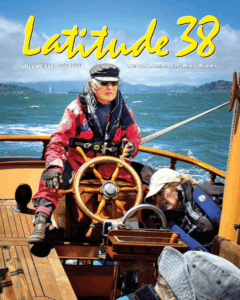
Ken Inouye helms Makani Kai,
Master Mariners Regatta 2026
Copyright 2026, Latitude 38 Media