
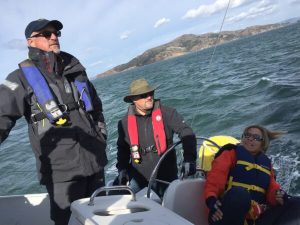
 It’s the beginning of the real sailing season on San Francisco Bay. That means sailors of all stripes will need to prepare for our usual strong winds. Most days, wind can be expected above 15 knots, and often closer to 20 knots, particularly in the afternoon.
Most keelboats are designed to handle that kind of wind with little problem — but most will perform better if they’re reefed. At anything above 15 knots of wind, most keelboats will become overpowered and thus be slow and uncomfortable with full sails.
 So how do you reef?
There are a few methods. The first is to do it at the dock before you leave. This is perhaps the easiest way to do it, but it’s only possible if the wind is coming from a convenient direction.
• With the boat pointing roughly into the wind, release the mainsheet, raise the mainsail and set your reef tack. Tension the halyard completely.
• Release the vang and haul the reef outhaul until the reef clew cringle is within an inch or two of the boom.
• Reset the vang.
• Role up the bunt — the lower unused part of the mainsail — and tie it off through one more reef points.
• Drop the sail without releasing reef tack or reef outhaul to leave the slip under motor.
The second is to reef when raising your mainsail after leaving the marina.
• Same process as above but under motor with boat pointing into the wind.
The third is to reduce sail by reefing under way after having your mainsail up all the way. This is often the most complicated method.
• Get into a position so that your mainsail luffs. Do this by motoring into the wind or by heaving to.
• With your mainsail luffing and with main sheet loose, ease the main halyard and set your reef tack. Haul your main halyard taught.
• Release the vang and haul the reef outhaul so that the clew cringle is within an inch or two of the boom.
• Reset the vang.
• Role up the bunt — the lower unused part of the mainsail — and tie it off through one or more reef points.
Heaving to is often the easiest and most convenient way to reef while under way.
• While sailing on a close haul or close reach course, tack the boat without releasing the jib sheet.
• Release the mainsheet entirely so that the mainsail luffs.
• After the bow comes through the wind, steer to keep the boat from bearing away. As the boat slows, the helm will be entirely or almost entirely over.
• When the boat has essentially stopped, the helm and the backwinded jib are working against each other. All you need to do is keep the helm all the way over. The boat will oscillate a bit toward and away from dead upwind while the mainsail luffs.
• With the main luffing, the boat will slowly move downwind and forward, giving the crew time to reef.
• The only requirement is that the skipper ensure there’s sufficient space for the boat to drift slowly while heaved to.
• Once the mainsail is reefed, getting under way is a matter of releasing the windward jib sheet and setting sails properly.Heaving to is useful for more than just reefing. The point of heaving to is to set your boat up so it can generally handle itself while you deal with something else. By “handle itself,” I mean the boat won’t need someone’s constant attention to maintain course or direction. Because the boat is still considered under way, the skipper will still need to maintain an adequate lookout to avoid a collision and generally avoid difficulty and stay safe.
Also, keep in mind that even while heaved to, a vessel is still subject to right-of-way rules. So, if possible, you should set your boat up for the best chance of having right of way while heaved to. You can do that by starting your heaving to maneuver from a port tack. If you do that, when you have completed heaving to, your main boom will be over the port side of the boat, meaning you will be, by definition, on starboard tack.
Your boat will also be pointing generally upwind — on a close reach or close-hauled course.
That means that you’ll have right of way over most other vessels. Motor vessels not otherwise privileged by being restricted in ability to maneuver, for example, will have to avoid you. So will most sailing vessels unless they are coming toward you from downwind.
Reefing and heaving to give you some strategies for dealing comfortably with some of the exciting winds that San Francisco Bay is famous for. Go out and have fun!